
What Is Double-Firing and Why Does It Make Ceramics Better?
VIETNAMESE CRAFT & ORIGIN STORY — BRAND AUTHORITY
Diego Acevedo
5/11/20264 min read
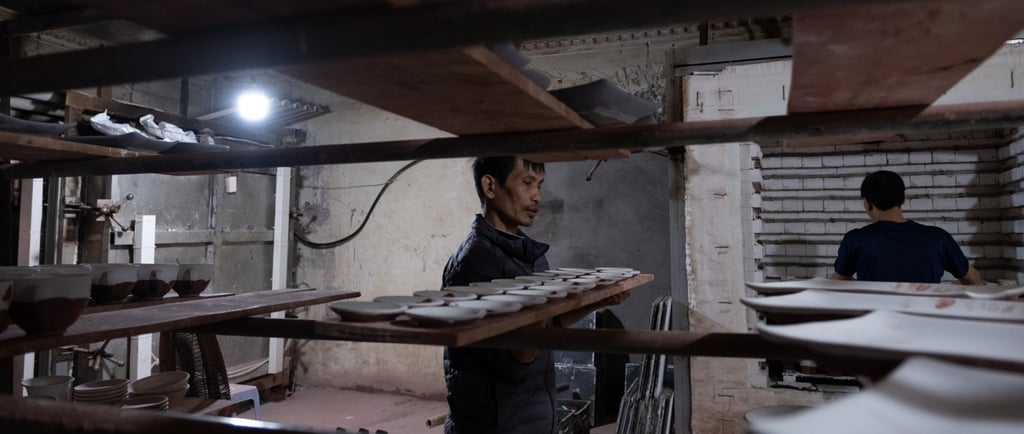
When a ceramics supplier tells you their pieces are 'double-fired,' it is easy to treat this as a technical detail — something to note and move on from. But double-firing is the single most important technical differentiator between tableware that performs in a professional kitchen and tableware that deteriorates within a season.
Understanding what happens inside the kiln, and why doing it twice matters, will change how you evaluate every tableware purchase you make from here forward.
The First Fire: Creating the Bisque
Raw clay — even after it has been shaped, air-dried, and sat waiting in a workshop for days — is fragile. It is still essentially compacted earth, and if you put it directly into a high-temperature kiln with glaze applied, the results are unpredictable at best and catastrophic at worst. The glaze and the clay body respond to heat at different rates; without the bisque stage, the piece is likely to crack, warp, or produce a glaze that sits incorrectly on the surface.
The first firing — called the bisque fire — addresses this by taking the piece to a lower temperature (typically around 900–1000°C) without any glaze applied. This fire transforms the raw clay into a stable, porous ceramic body that has the strength to be handled, glazed, and returned to the kiln without risk of damage. The clay particles begin to sinter — bonding together at their contact points — without yet reaching the full vitrification of the finished piece.
The result is what potters call bisqueware: white, slightly chalky in appearance, and porous enough to absorb the glaze that will be applied in the next stage.
Glazing: The Stage That Makes It Vulnerable
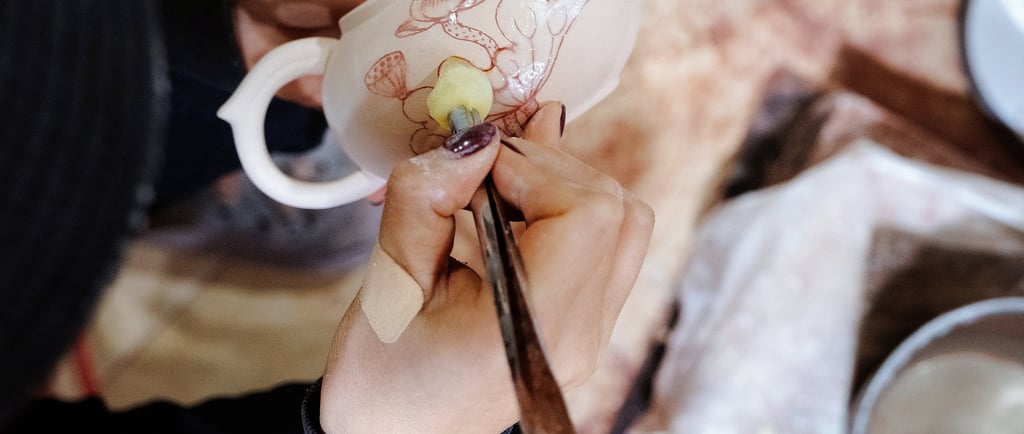
After the bisque fire, the piece is glazed by hand. This is where the visual character of the piece — its colour, its texture, its surface depth — is determined. At Annamis, our glazes are developed in collaboration with our craft partners to achieve specific aesthetic and technical outcomes: warmth without being heavy, texture without competing with plating, and a surface that holds its character after hundreds of commercial dishwasher cycles.
Glazing a bisqueware piece requires skill and consistency. Too thin and the glaze fires patchy; too thick and it crawls or bubbles in the second kiln. Our craft partners have spent careers developing the intuition to apply glaze at the right weight and distribution for each piece form.
The Second Fire: Vitrification
The second firing — the glaze fire — takes the piece to a significantly higher temperature than the bisque. For our Circle, Square, and Triangle collections, this is a full porcelain fire at temperatures that fully vitrify the clay body.
Vitrification is the key word here. At this temperature, the clay particles do not merely sinter — they fuse. The microscopic spaces between clay particles close. The body becomes glass-like in its density, approaching zero water absorption (less than 0.5% for our core collections). At the same time, the glaze melts and fuses chemically to the clay surface, creating a bond that is not a coating but an integration.
The result is a piece that is fundamentally different from a single-fired ceramic. The density resists chipping. The integrated glaze does not scratch or peel. The vitrified body does not absorb water, meaning it does not crack under the thermal cycling of a commercial dishwasher. It does not harbour bacteria in micro-cracks that non-vitrified pieces develop over time. It is, in short, a piece built for use.
Why Single-Fired Pieces Fall Short in Service
Single-fired ceramics — where glaze and clay are fired together in a single pass — are faster and cheaper to produce. They can look beautiful on day one. But the technical compromise is real: without the bisque stage, the clay body is less fully vitrified, which means higher water absorption, less resistance to thermal shock, and a glaze bond that is more susceptible to crazing (fine surface cracks) over time.
In a home setting, a single-fired piece may last years without visible degradation. In a restaurant kitchen, cycling through commercial dishwashers at high temperatures twice or three times a day, the compromise becomes visible within months. Glazes begin to craze. Chips appear at rim edges. The piece that looked premium on arrival starts to look tired within a season.
This is why, when evaluating any handcrafted tableware supplier, the firing specification is the first technical question to ask — before price, before lead time, before aesthetics.
Our Diamond Collection: A Different Technical Specification
It is worth addressing our Diamond collection directly here. Diamond pieces are single-fired stoneware, fired at 1200–1250°C with a water absorption of 2–3%. This is not a compromise product — it is a different technical category designed for a different use case.
At 1200–1250°C, Diamond stoneware is fired significantly hotter than lower-quality single-fire ceramics. The result is a durable, food-safe piece that is dishwasher safe and microwave safe, suitable for high-volume hospitality environments where the price point of double-fired porcelain does not match the brief. Diamond is our accessible tier — not our premium tier — and we are transparent about that distinction.
FAQ
Q: How do I identify whether a ceramic piece is double-fired?
A: Ask the supplier directly, and ask for the firing temperature specifications for both firings. A supplier who cannot provide this information likely cannot verify their own production process.
Q: Does double-firing significantly increase the cost of the piece?
A: Yes — the additional kiln time, energy, and handling involved in a second firing adds to the cost of production. This is reflected in the price differential between our Circle/Square/Triangle collections and our Diamond stoneware.
Q: Is vitrified porcelain completely chip-proof?
A: No ceramic is chip-proof. Vitrified porcelain is significantly more chip-resistant than non-vitrified alternatives, particularly at the rim where impacts occur most frequently. Correct stacking and handling practices remain important.
Q: Can double-fired pieces go in the microwave?
A: Yes. All Annamis pieces across all collections are microwave safe. The vitrification of our core collections means they are particularly stable under microwave heating cycles.
→ Request your sample set at annamis.com/for-restaurants
Terms & Conditions
Privacy Policy


© 2024 ANNAMIS LTD. UK Company Number 15690972
9-11 New Broadway, London, W5 5AW, UK.
© 2025 DAC GLOBAL SZOO. PL. NIP 5342704617.
Gruntowa 3a, Wolica, Poland, 05-830.
All rights reserved.
Site created using Hostinger.com
Telephone: +44 7858221374 / +48 739440679
Email: info@annamis.com
United Kingdom - European Union - Vietnam