
How to Set a Fine Dining Table: The Complete Restaurant Guide
RESTAURANT OPERATIONS & TABLE SETTING — PRACTICAL GUIDES
Diego Acevedo
5/25/20264 min read
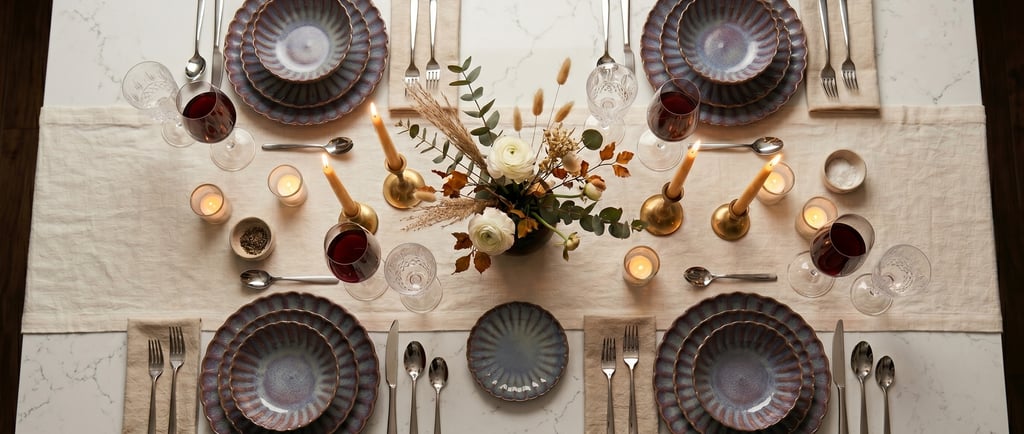
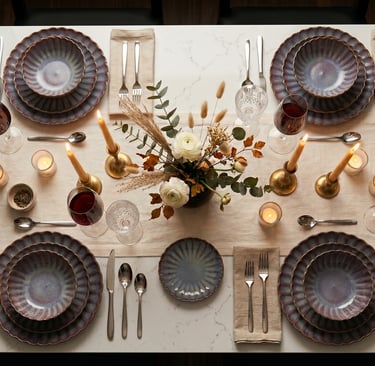
A fine dining table setting is a piece of communication before anyone sits down. It tells the arriving guest something about the level of care they are about to experience. It sets a baseline of expectation that the service team and kitchen are then expected to meet or exceed. Done well, it creates a calm, considered impression that makes everything that follows feel intentional.
Done poorly — misaligned cutlery, mismatched tableware, a table that looks assembled rather than composed — it creates a small, persistent anxiety in the guest that the best food in the world struggles to fully resolve.
This guide covers the fundamentals of fine dining table setting: the logic behind the conventions, how to apply them in practice, and how tableware choice shapes the outcome.
The Foundation: Charger and Cover Plate
The charger — also called a base plate or presentation plate — defines the cover. It is the largest piece on the table, positioned one inch from the table edge, centred precisely in front of each chair. In fine dining, the charger is rarely used to serve food directly; its function is structural and aesthetic: anchoring the setting visually and giving guests a focal point from the moment they sit.
For restaurants that choose to use a cover plate rather than a charger, the same positioning principle applies — one inch from the edge, centred, consistent across every cover. Consistency here is not a detail; a cover plate even slightly off-centre relative to its neighbours creates a visual tension that guests register unconsciously.
Annamis plates — particularly from our Circle and Square selections — serve excellently as cover plates: their weight communicates quality the moment a guest's eye falls on them, and their surface character invites attention in a way that blank white china does not.
Cutlery Placement: The Logic Behind the Convention
Western fine dining cutlery convention is not arbitrary. It evolved to communicate course progression to the guest without words: work from the outside in. The cutlery furthest from the plate is used first; as courses progress, guests work toward the plate.
Forks on the left, knives and spoons on the right. Knife blades face inward (toward the plate). Dessert cutlery sits above the plate — dessert fork facing right, dessert spoon facing left. All cutlery is aligned to the same baseline, approximately one inch from the table edge.
The practical detail that separates a good setting from a great one: every piece of cutlery should be positioned so it can be picked up with a single, natural motion without adjustment. This means attending not just to alignment but to spacing — cutlery placed too close together becomes awkward to handle.
Glassware: Height, Order, and Clarity
Glassware is set above and to the right of the cover plate. Water glass first — closest to the plate — then wine glasses extending outward in the order they will be used: white wine to the inner right, red wine to the outer right, or champagne/sparkling above both if included.
Clean glassware is non-negotiable. Lipstick marks, water spots, and fingerprints on glassware communicate negligence more loudly than almost any other table detail. In a high-volume service environment, build glass polishing into your mise en place as a standard task, not an occasional one.
Napkin Presentation
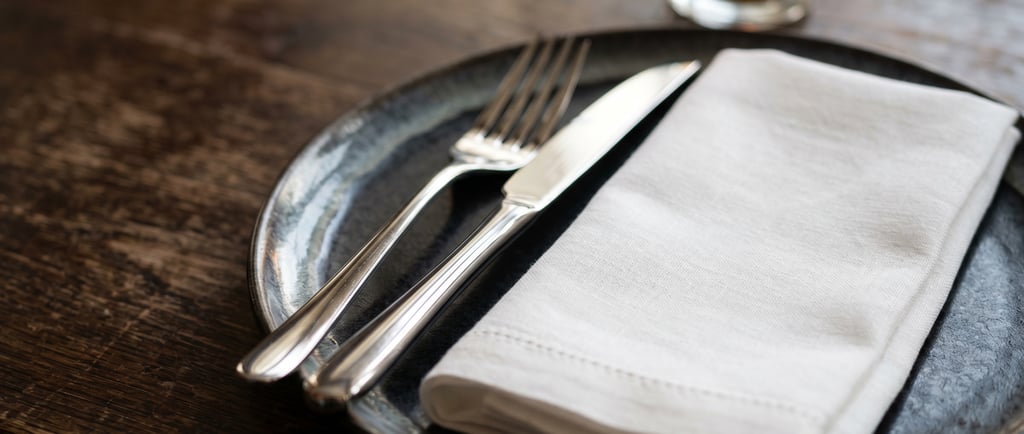
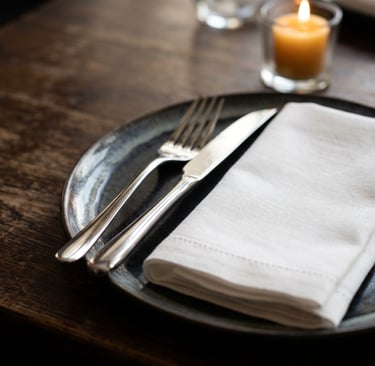
Fine dining napkin presentation falls into two broad approaches: flat on the cover plate or to the left of the forks. In either case, the fold should be clean and consistent. Over-elaborate napkin sculptures are generally considered more casual or theatrical than fine; a crisply folded napkin rectangle or a single clean fold communicates the same care with more restraint.
If service begins with a cover plate in place, the napkin typically sits on the plate and is presented to the guest by the service team when they are seated. If the cover plate is removed before seating, the napkin sits to the left.
Tableware Cohesion: The Detail That Sets the Tone
Every element on the table should feel as though it belongs to the same considered decision. Tableware mixing — using plates from one collection, bowls from an entirely different visual language, cups that share no relationship to either — creates visual noise even when individual pieces are attractive in isolation.
The Annamis collection architecture is designed to address this directly. Each selection (Circle, Square, Triangle, Diamond) provides a complete system: plates, bowls, ramekins, and cups that share glaze family and aesthetic intention. You can mix selections for deliberate visual contrast — a Circle dinner plate with a Square side plate, for example — but the relationship between pieces remains legible rather than accidental.
FAQ
Q: How far in advance should a fine dining table be set?
A: Tables should be fully set at least 30 minutes before service begins, with a final check by the floor manager. Chargers or cover plates should be inspected for watermarks, chips, or positioning inconsistencies.
Q: Should charger plates be removed before or after the starter is served?
A: Convention varies by restaurant concept. In traditional fine dining, chargers are removed with the starter plate when the main course arrives. In many contemporary settings, chargers are left through the entire meal as an anchor piece.
Q: How do I maintain consistent positioning across all covers?
A: Use a positioning guide or template — even a simple piece of card cut to the correct distance from the table edge — as a training tool during onboarding. Consistency becomes habit with repetition.
Q: Can Annamis pieces be used as charger plates?
A: Yes. Our larger dinner plates from the Circle and Square selections work well in a charger role. Contact us if you want guidance on which specific dimensions suit your cover plate requirements.
→ Request your sample set at annamis.com/for-restaurants
Terms & Conditions
Privacy Policy


© 2024 ANNAMIS LTD. UK Company Number 15690972
9-11 New Broadway, London, W5 5AW, UK.
© 2025 DAC GLOBAL SZOO. PL. NIP 5342704617.
Gruntowa 3a, Wolica, Poland, 05-830.
All rights reserved.
Site created using Hostinger.com
Telephone: +44 7858221374 / +48 739440679
Email: info@annamis.com
United Kingdom - European Union - Vietnam