
How Many Plates Does a Restaurant Need? A Practical Ordering Guide
RESTAURANT OPERATIONS & TABLE SETTING — PRACTICAL GUIDES
Diego Acevedo
5/18/20263 min read
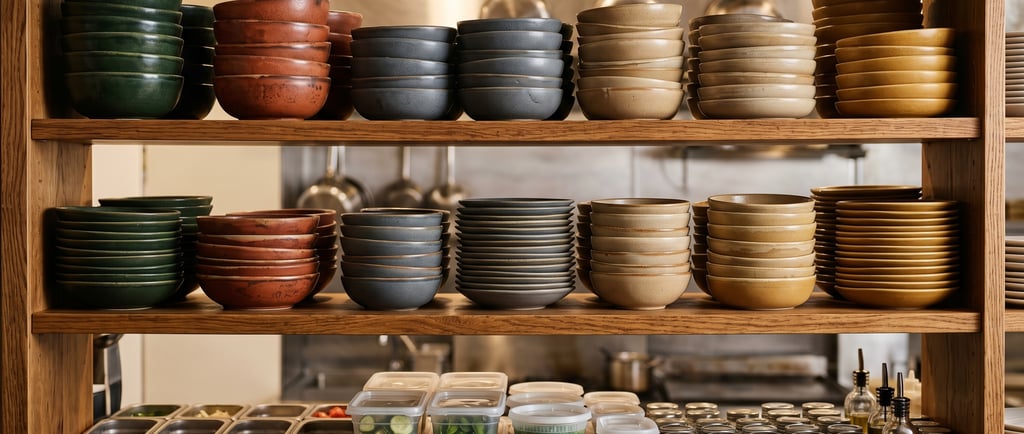
It is one of the most practical questions in restaurant planning, and one that almost nobody answers directly. Most suppliers are happy to take your money without helping you understand exactly how much to order — leaving you either under-stocked on a busy Saturday or sitting on surplus inventory that cost you working capital.
This guide gives you the numbers, the logic behind them, and how to apply them to your specific operation.
The Core Formula: The 3x Rule
The industry standard starting point is to order 3 times your cover count for each plate category. If you seat 40 covers, order 120 dinner plates as your minimum. This accounts for three simultaneous 'locations' your tableware occupies at any given moment during service:
1. On the table — in active use during service.
2. In the dish pit — being washed and drying.
3. In reserve — resting on the shelf, accounting for breakage and buffer during peak service when dishwasher cycles may lag behind demand.
Adjusting for Your Service Style
The 3x rule is a baseline. Your actual requirement depends on your service model:
High-turnover restaurants (75+ covers per sitting, fast casual-fine dining): move to 3.5x or 4x. The speed of service means more plates are in circulation simultaneously and the dishwasher cycle becomes the bottleneck.
Tasting menu or long-form dining (single sitting, 2.5+ hour experience): 3x is usually sufficient. Plates return to the kitchen slowly and the dishwasher has time to keep pace.
Multi-outlet or event catering: calculate per outlet or event peak cover count and add a shared buffer of 20% across the operation.
Category by Category Breakdown
Do not apply a single formula across every item type. Different pieces have different replacement rates and usage patterns:
Dinner / main course plates: 3–3.5x covers. Highest usage, highest breakage rate.
Side plates / bread plates: 2.5x covers. Lower breakage, used less intensively.
Soup bowls / pasta bowls: 3x covers if featured prominently on menu; 2x if occasional.
Ramekins and side dishes: 4–5x covers. Small and high-volume, frequently in use across multiple courses.
Cups and mugs: 2.5x covers for coffee and tea service. Breakage rate is lower when handled carefully.
Building In a Breakage Reserve
Breakage is inevitable in a professional kitchen. The industry average runs at 10–20% of stock per year for active tableware. For handcrafted pieces, where production lead times are longer than mass-produced alternatives, building a breakage reserve into your initial order is genuinely important.
Our recommendation for Annamis customers: add 15% to your calculated quantity as a reserve stock that lives in your storeroom. This means when a piece breaks — and eventually, one will — you replace it immediately from reserve and replenish the reserve on your next order cycle, rather than running short during service.
The Cost of Under-Ordering
Restaurateurs sometimes under-order handcrafted tableware to manage upfront cost. This is understandable, but it creates a more expensive problem downstream. Running short during service means substituting with mismatched pieces, compromising the visual consistency you paid for. And if the piece you need has a production lead time of 8–12 weeks, you may be compromising your table for an entire season.
Order correctly once. It is cheaper than fixing it twice.
FAQ
Q: Should I order all my tableware from one supplier?
A: For visual cohesion, yes — particularly for your core pieces. Mixing collections from different suppliers rarely works as well in practice as it appears on a mood board.
Q: Can I place a smaller initial order and top up later?
A: Yes. Annamis supports phased ordering. We recommend starting with a sample set, then placing your operational order. Top-up orders are possible, though production lead times apply.
Q: What happens if a piece from my collection is discontinued?
A: We communicate any collection changes to existing customers in advance and offer bridge ordering windows. For custom or bespoke pieces, we discuss long-term supply arrangements at the outset.
Q: How do I calculate for a restaurant that also does private dining?
A: Calculate your main dining room and private dining room separately using the 3x rule for each, then take 75% of the combined total (since both spaces rarely operate at full capacity simultaneously).
Q: What is the minimum order for Annamis?
A: Contact us directly — minimums vary by collection and customisation level. We always recommend starting with a sample set.
→ Request your sample set at annamis.com/for-restaurants
Terms & Conditions
Privacy Policy


© 2024 ANNAMIS LTD. UK Company Number 15690972
9-11 New Broadway, London, W5 5AW, UK.
© 2025 DAC GLOBAL SZOO. PL. NIP 5342704617.
Gruntowa 3a, Wolica, Poland, 05-830.
All rights reserved.
Site created using Hostinger.com
Telephone: +44 7858221374 / +48 739440679
Email: info@annamis.com
United Kingdom - European Union - Vietnam